
Prix de l’Abbaye de Longchamp History: The final sprint
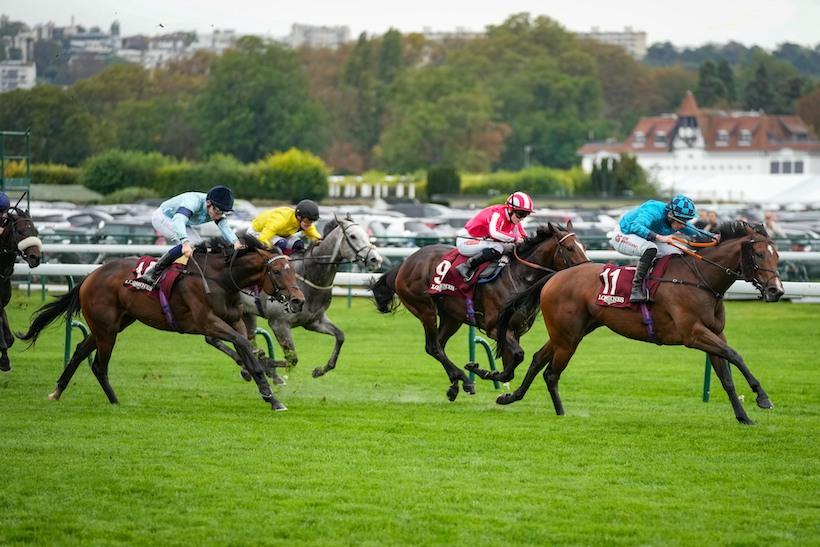
Photo scoopdyga.com
October, ParisLongchamp
PRIX DE L'ABBAYE DE LONGCHAMP LONGINES
Group 1, 2-year-olds and up, 1,000 meters/5f, €350,000
Created in 1957
Race Record: 54"30 by Habibti in 1983
2024 Winner: MAKAROVA (f5, GB by Acclamation ex Vesnina by Sea the Stars), owned by Brightwalton Bloodstock Ltd, bred by Brightwalton Bloodstock Ltd, trained by E.C.D. Walker, ridden by Tom Marquand.
2025 marks the 69th running of the race.
The 2024 Edition
Sunday, October 6, 2024, ParisLongchamp Racecourse (Paris). – Quickly well-placed behind the leaders of the Prix de l'Abbaye de Longchamp Longines (Gr1), the sprint on the occasion of the Qatar Prix de l'Arc de Triomphe (Gr1), the 5-year-old mare Makarova (Acclamation) made the difference at the right moment and then stayed a good length ahead of the favourite Bradsell (Tasleet), who narrowly held off the strong finish of Believing (Mehmas).
Sixth last year in this same race, Makarova has been regularly placed since then, notably finishing recently in the Flying Five Stakes (Gr1), where the trio was the same as in this race, only the order of finish of the first three changing. Her sister by Kingman was sold for £140,000 to Moyglare Stud Farm at the Tattersalls sales last year.
History
The race owes its name to the abbey that was located on the plain of "Longchamps," on the northern edge of the racecourse. A royal abbey if ever there was one, its foundation fulfilled a wish of Isabelle of France, daughter of Blanche of Castile and sister of King Louis IX (Saint Louis). "My brother gives me 30,000 Parisian livres," she wrote to Héméric, chancellor of Notre-Dame, whose advice she loved; "should I use them to found a monastery or a hospital?" Héméric preferred the monastery. The chosen location was a strip of land of forty acres along the Seine, facing the ferry of the wine-growing village of Suresnes. Thus, on June 10, 1256, the king laid the first stone of the monastery, intended for the community of the "Enclosed Minor Sisters of the Humility of Our Lady."
Isabelle of France was the first abbess of the abbey, which was surrounded, as it should be, by a farm and a mill. Pious practices were long the rule of the monastery. But with the wars, the austerity of the rule relaxed in the Middle Ages. The secular spirit was introduced into the abbey when it began to welcome as "lady boarders" isolated women attracted by the beauty of the site and the proximity of the city, then young girls of the highest nobility entrusted to the nuns to complete their education until marriage. Fashion arrived, and "a worldly Longchamp succeeded the austere cloister founded by the sister of Saint Louis." Music and singing were taught by a famous singer, Mlle Le Maure, who sang at the services. People came to hear her. The Orleans family, which used to spend a fortnight at Easter in its neighboring residence of Saint-Cloud, went to Longchamp for the Tenebrae service, followed by people from the court in grand carriages. Renowned actresses came to be seen there, such as Mlle Guimard on March 30, 1768. Fashion helping, the crowds turned into a crush. The Longchamp meeting became a "vanity fair," and the Archbishop of Paris decided to close to the public access to "a church where one went as to the theater." But the die was cast, and until the Revolution, Longchamp continued to be the meeting place for all those who wanted to see and, above all, be seen. At the Revolution, the nuns were driven out and the abbey was razed.
A pleasure house known as the "Château de Longchamp" was built on the site of part of the abbey. The city of Paris housed its curators there, and then it was occupied by Alfred Chauchard, a famous collector. After having been the headquarters of the International Center for Childhood, it also housed the WWF (World Wide Fund for Nature), before being dedicated to receptions: "Noctis and the Good Planet Foundation have joined forces to open an eco-responsible space in Paris: Le Domaine de Longchamp, a place surrounded by hundred-year-old trees, composed of a Château and a Clairière (clearing) with 1,000m2 dedicated to all types of events and private functions."
The race was run at Chantilly in 2016 and 2017 during the construction work at Longchamp, which it returned to in 2018.
Doubles
Four horses have won the race twice: Texanita (1963, 1964), Gentilhombre (1976 dead-heat, 1977), Commited (1984, 1985), and Lochsong (1993, 1994). Despite repeated efforts, Yours failed to win the race. Second in 1964 and 1966, he was only third at age 6 in 1967. Winner at age 3 in 1967, Pentathlon could only finish third two years later. Third in 1978, Double Form redeemed himself by triumphing the following year at age 4. Sharpo, second in 1980 and 1981, managed to win the following year at age 5. Habitbi, winner at age 3 in 1983, had to settle for second place the following year. Similarly, Keen Hunter, winner at age 4 in 1991, was only second the following year. Hever Golf Rose, winner at age 4 in 1995, could do no better than third in 1996. Patavallian, winner in 2003, was unplaced in 2004. Conversely, the mare Imperial Beauty, only second in 1999, won at age 5 in 2001. As for Avonbridge (full brother to Patavellian), winner in 2005, he had to settle for fifth place in 2004. Winner in 2016, Marsha took second place in 2017.
The Role of 2-Year-Olds
They got off to a flying start, winning in the very first year. Carrying the colors of François Dupré, the filly Texana beat her stablemates Polic (age 4) and Mystic (age 3). She finished the season unbeaten. It was her eleventh victory. She set a new record in France, the previous one being held by Mlle de Fligny, winner of ten races out of twelve attempts at age 2 in 1868 (see Grand Critérium). At the end of the century, another filly, Alips, would also win eleven races at age 2, in 1996. But out of seventeen attempts (with six placings), most often in claiming races and for four different owners.
The third and fourth editions of the Prix de l'Abbaye saw the success of two other 2-year-old fillies, Sly Pola and High Bulk. In 1963, Texanita imitated her older sister Texana, while doing a little less well, with only eight victories in eleven starts. And two more victories for 2-year-olds in 1965 and 1966 with two horses owned by Prince Karim Aga Khan, Silver Shark and Farhana. Thus, after ten years, there were six victories to the credit of 2-year-olds. After this fireworks display, it was less impressive: three second-place finishes in 1967, 1968, and 1969, then only two victories, that of Sigy in 1978 and The Platinum Queen in 2022.
International Visitors
It was only in its eleventh edition, in 1967, that the Prix de l'Abbaye was won by a foreign runner, the 3-year-old Pentathlon, who came from Germany. From then on, the way was open, and foreigners rushed to the Abbaye. Since 1972, there have been only seven victories for horses trained in France, all the rest for visitors.
Sprinting in its Purest Form
66.3 km/h is the speed achieved – standing start in the stalls – by Habibti in 1983 when she covered the 1,000 meters of the Prix de l'Abbaye de Longchamp in 54"30. This is the record for the distance in France. Four seconds faster than the record set on the same track (but starting behind the tapes of the starting gate) in 1929 by La Fayette (58"72). The improvement of the equine breed is not an empty phrase. While Habibti can boast of this record, in the Prix de l'Abbaye roll of honor, there are other illustrious specialists in speed. Particularly, the aforementioned sisters Texana and Texanita, Sly Pola (1959), Fortino (1962), Be Friendly (1968), Tower Walk (1969), Deep Diver (1972, winner by four lengths), Lianga (1975, who had just won the Prix Jacques Le Marois over 1,600 meters), Double Form (1979, head and nose in front of Kilijaro and Greenland Park), Marwell (1981, tenth victory of his career in thirteen races), Dayjur (1990, sixth winning sprint of the year), Hever Golf Rose (1995, already winner in the year of seven sprints in Italy, Germany, Sweden, and England, her country of origin), Kistena (1996, beating her training companion Anabaa in extremis), and Agnes World (1999, who came from Japan to conquer this internationally renowned Abbaye). Note that the French horse Marchand d'Or, winner in 2008, covered the course in 54"40, the fastest time recorded since Habitbi's record in 1983.
The Female Sprinters
Of all the mixed Group 1 races, it is in the Prix de l'Abbaye that females achieve the greatest success: 39%. They are almost equal to males, with 27 victories to their credit out of 69 (there was one dead-heat).
Leading Owners
- François Dupré (4 wins): Texana (1957), Fortino (1962), and Texanita (1963, 1964).
- Robert Sangster (4 wins): Commited (1984), Double Schwartz (1986), Handsome Sailor (1988), and Carmine Lake (1997).
- Aga Khan IV (3 wins): Silver Shark (1965), Farhana (1966), and Moubariz (1974).
- Jeffrey Colin Smith (2 wins): Lochsong (1993, 1994).
- Daniel John Deer (2 wins): Patavellian (2003) and Avonbridge (2005).
Leading Trainers
- François Mathet (8 wins): Texana (1957), Edellic (1958), Fortino (1962), Texanita (1963, 1964), Silver Shark (1965), Farhana (1966), and Moubariz (1974).
- Etienne Pollet (3 wins): Sly Pola (1959), High Bulk (1960), and L'Epinay (1961).
- Ian Balding (3 wins): Silver Fling (1989) and Lochsong (1993, 1994).
During the first ten years, two trainers monopolized the victories, seven for François Mathet and three for Etienne Pollet. It should also be noted that François Mathet was the trainer in 1957 of the first three finishers (Texana, Polic, Mystic), just as Christiane Head-Maarek was in 1996 the trainer of the first two finishers, Kistena and Anabaa.
Leading Riders
- Yves Saint-Martin (5 wins): Fortino (1962), Texanita (1963), Silver Shark (1965), Farhana (1966), and Lianga (1975).
- Lester Piggott (4 wins): Tower Walk (1969), Balidar (1970), Moorestyle (1980), and Mr Brooks (1992).
- Lanfranco Dettori (3 wins): Lochsong (1993, 1994) and Var (2004).
The information relating to the history of Longchamp Abbey was collected from two articles published in Le Sport Universel Illustré. The first, dated October 9, 1925 (No. 1180), was written by Raymond de Fontanes. The second, dated July 2, 1932 (No. 1531), was written by Henry Lee.