
Historique du Prix du Conseil de Paris : Avant l'Arc
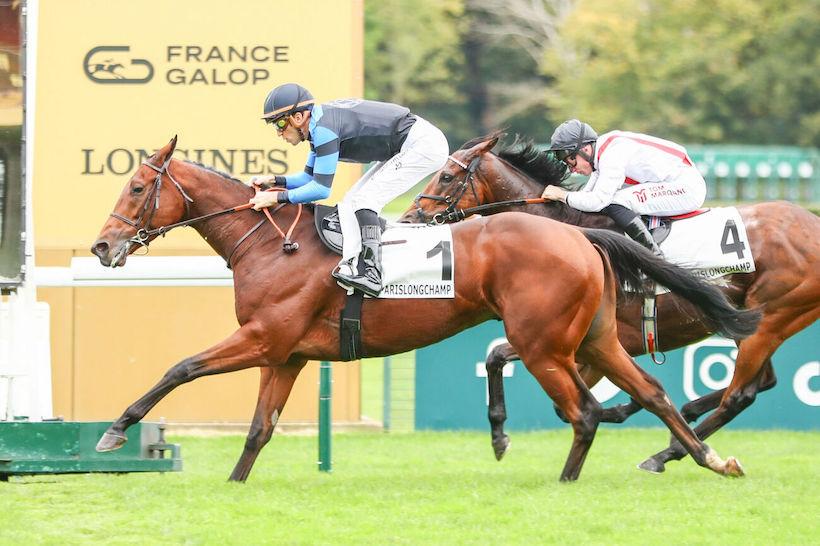
Photo scoopdyga.com
Octobre, ParisLongchamp
PRIX DU CONSEIL DE PARIS
Group 2, 3-year-olds and up, 2,200 meters, €130,000
Created in 1893 (Prix du Conseil Municipal)
2023 Winner: GOLIATH (g4, GER by Adlerflug ex Gouache (Shamardal), owned by Resolute Bloodstock, Philipp von Ullmann, bred by Gestüt Schlenderhan, trained by Francis-Henri Graffard, ridden by Christophe Soumillon.
Race Record: 2’ 27’’ 4 by De Quest in 1995.
The race will be run for the 127th time in 2025.
The 2024 Edition
Sunday, October 20, 2024, ParisLongchamp Racecourse (Paris). – A heavy favourite for the Prix du Conseil Municipal (Gr2), the final Group race of the season at Longchamp, Goliath (Adlerflug) lived up to expectations despite making his comeback run and conceding two kilos to his rivals. After racing prominently, the representative of Resolute Racing, which purchased the 4-year-old gelding after his victory this summer in the King George VI and Queen Elizabeth Stakes (Gr1) at Ascot, held off the strong challenge of the English raider Hamish (Motivator) to win comfortably by half a length. The race was run on heavy ground.
A good length further back in third was Marquisat (Zarak), who finished well on his comeback after a 140-day layoff.
Goliath has gradually progressed to the highest level and has truly blossomed this season. Bred by Georg von Ullmann, who remains his co-owner, he is the first foal out of Gouache (Shamardal), a Listed winner over 1800 meters at age 4 in Germany. She was sold in foal to Blackbeard last year at Arqana for €200,000 to Agrolexica International Trading BV. After Goliath, the mare has produced two fillies, an unraced 3-year-old and a full-sister to Goliath born in 2022, who is in training with Peter Schiergen.
His dam, Guantana (Dynaformer), won at the same level as Gouache before also giving birth to several good winners. She is a sister to Guignol (Cape Cross), a dual Group 1 winner and promising stallion. This is also the family of Guadalupe (Monsun).
History
Created in 1893 under the name Prix du Conseil Municipal, it took its new name in 1974 after the reform of the statutes of the city of Paris. The race was not run from 1915 to 1918 and in 1939. It was run at Auteuil over 2,600 meters in 1940 and at Tremblay over 2,300 meters in 1943 and 1944. The four editions between 2015 and 2018 took place at Chantilly before and after the renovation of ParisLongchamp. For its return to ParisLongchamp in 2019, it was shortened from 2,400 to 2,200 meters to offer a different alternative to those disappointed by the big race at the beginning of October.
Thirty years after the creation in 1863 of the Grand Prix de Paris, an international race reserved for 3-year-old horses, the Société d'Encouragement decided to set up another major global event open to both 3-year-olds and their elders. This was the Prix du Conseil Municipal, created in 1893. The date chosen was early October when the young horses had had time to develop. The distance chosen was 2,400 meters – the distance of the Epsom Derby and the Prix du Jockey Club at Chantilly – considered ideal for testing the quality of Thoroughbreds. Conditions: weight-for-age race (3-year-olds = 53 kilos, 4-year-olds and up = 58 kilos) with penalties and allowances that could reach six kilos each, the weight difference between two horses being able to rise to twelve kilos. Prize money: 100,000 francs to the winner, 15,000 francs to the second, 7,500 francs to the third. In addition, 7,500 francs to the breeder of the winner if he was born in France. This was, after the Grand Prix de Paris – endowed with 200,000 francs since 1892 – the largest purse for a flat race in France. The creation of the race, its financing, and its name were some of the conditions for the signing of the lease of July 25, 1891, extending until December 31, 1941, the rental of Longchamp Racecourse to its owner, the City of Paris, which, having begun on July 1, 1856, was to end on June 30, 1906.
Until the creation of the Prix de l'Arc de Triomphe in 1920, the Prix du Conseil Municipal quickly became the star event of the autumn at Longchamp. Indeed, the race conditions, which were very severe for the best horses, did not prevent many of them from participating. Thus, during the first twenty-two editions of the race – from 1893 to 1919 – the fields were large, averaging 13.5 runners. From the first year, there were 16 starters. The records were set in 1912 (20) and 1919 (21). Only three times were there fewer than ten starters: 7 in 1899, 8 in 1904, and 9 in 1905. Ten times out of twenty-two, the winner successfully carried the six-kilo penalty. These were, at age 3, Omnium II (1895), Gardefeu (1898), Maintenon (1906), and Nimbus (1913); at age 4, Omnium II (1896), La Camargo (1902), Macdonald II (1905), Biniou (1908), and Ossian (1910); and at age 5, La Camargo (1903). Their names can be found on the list of classic winners.
Initially competing with the Prix de l'Arc de Triomphe, which was run a week earlier (on the first Sunday in October), the Prix du Conseil Municipal was from 1925 onwards delayed by a week, offering a fortnight's rest to horses that had participated in the Arc. Few horses took advantage of this opportunity, and there are only eight horses placed in the Arc who have won the Prix du Conseil Municipal in the same year. These were Fléchois (2nd in 1921), Macaroni (3rd in 1932), Assuerus (4th in 1933), Cousine (2nd in 1936), Basileus (4th in 1945), Goyama (2nd in 1947), Timmy Lad (4th in 1964), and Kamaraan (4th in 1974).
Five horses have won the race twice: Omnium II (1895, 1896), La Camargo (1902, 1903), Porphyros (1940, 1942), Kamaraan (1974, 1975), and Montare (2005, 2007).
It should be noted that fillies have been very discreet in the race, achieving only 21 victories out of 120. However, they have nine wins in the last thirty years thanks to Her Highness (1988), Dancienne (1993), Annaba (1996), Vallée Enchantée (2003), Pride (2004), Montare (2005, 2007), Traffic Jam (2017), and Listen In (2018).
The foreign runners
During the twenty-one editions of the race before the First World War, foreign participation was frequent, and three runners from across the Channel were victorious: Best Man (1894), Winkfield's Pride (1897), and Kilmarnock II (1901). Nevertheless, the most prestigious of their representatives suffered a bitter defeat. This event took place on October 9, 1904. On that day at Longchamp, astonishment reigned. The illustrious English visitor, Pretty Polly, was beaten. 50/1 were the odds of the 3-year-old Presto II, who won the Prix du Conseil Municipal from start to finish at her expense. Explanation: a weight advantage of twelve pounds, but above all, the mud that the colt loved. Shocking! He was a former "claimer." She would be named "the greatest filly of the century" by the Racing Post in 1999.
There were no more foreign victories until 1957, the year of the success of the German filly Thila. Acquired by François Dupré, she participated again in the Prix du Conseil Municipal the following year. Still, she had to settle for sharing second place with Big Warrior, the victory going to the big outsider Tombeur (59/1). British success came in 1969 with Karabas, who was trained at Newmarket by Bernard Van Cutsem. Since then, visitors have had six victories, achieved by two horses trained by Clive Brittain (Jupiter Island in 1985 and Garden of Heaven in 1992), John Gosden (Annaba in 1996), Mark Johnston (Yavana's Pace in 2001), Joseph O'Brien (Baron Samedi in 2020), and William Haggas (Addeybb in 2022). In 2019, Subway Dancer won the race under the Czech training of Zdeno Koplik, a first!
Leading Owners
- Aga Khan IV (7 wins): Zamazaan (1968), Kamaraan (1974, 1975), Lashkari (1984), Altayan (1986), Daramsar (2006), and Vadamar (2011).
- Evremond de Saint-Alary (4 wins): Omnium II (1895, 1896), Basse Pointe (1911), and Porphyros (1940).
- Marcel Boussac (4 wins): Horatius (1941), Goyama (1947), Astana (1960), and Arcor (1962).
- Ecurie Wildenstein (4 wins): Sagace (1983), First Magnitude (1999) for Daniel Wildenstein, Vallée Enchantée in 2003 for the stable, partnered in Ming Dynasty (2015).
- Adolphe Abeille (3 wins): Callistrate (1893) and La Camargo (1902, 1903).
- Khalid Abdullah (3 wins): Sunshack (1994), De Quest (1995), and Crossharbour (2008).
- George Strawbridge (3 wins): Montare (2005, 2007) and Listen In (2018).
Leading Trainers
- André Fabre (8 wins): Village Star (1987), Sunshack (1994), De Quest (1995), First Magnitude (1999), Crimson Quest (2000), Crossharbour (2008), Prince Bishop (2010), and Manatee (2014).
- Henry Count (5 wins): Fléchois (1921), Come In (1935), Cousine (1936), Galène (1944), and Basileus (1945).
- Alain de Royer-Dupré (5 wins): Lashkari (1984), Altayan (1986), Pride (2004), Daramsar (2006), Vadamar (2011), and One Foot in Heaven (2016).
Leading Jockeys
- 4 wins each for: William Johnstone: Assuerus (1933), Vandale (1946), Espace Vital (1948), Worden (1952); and Yves Saint-Martin: Zamazaan (1968), Récupéré (1973), Sagace (1983), Lashkari (1984).
- Jay Ransch (3 wins): Presto II (1904), Maintenon (1906), and Luzerne (1907).
- Charles Bouillon (3 wins): Cerulea (1927), Galène (1944), and Basileus (1945).
- Maxime Garcia (3 wins): Arcadius (1956), Blue Net (1959), and Nyrcos (1963).
- Olivier Peslier (3 wins): First Magnitude (1999), Crimson Quest (2000), and Prince Bishop (2010).
- Christophe Lemaire (3 wins): Montare (2005, 2007) and Vadamar (2011).
- Thierry Jarnet (3 wins): De Quest (1995), Ange Gabriel (2002), and Saga Dream (2012).
- Christophe Soumillon (3 wins): Daramsar (2006), One Foot in Heaven (2016), Goliath (2024).