
Corrida History: A tribute to a great traveller
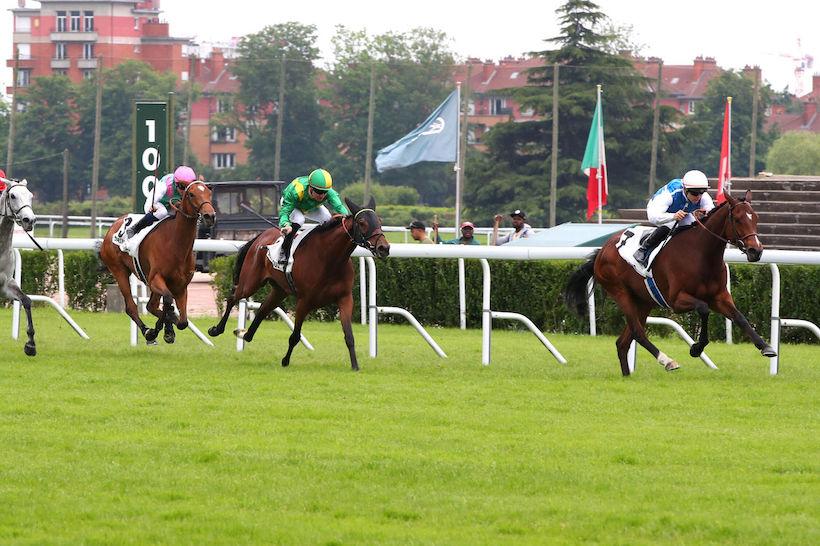
Photo scoopdyga.com
May, Saint-Cloud*
PRIX CORRIDA
Group 2, 4yo-and-up Filles and Mares, 2,100m/10.5f, €130,000
Created in 1979
Last winner: PENSÉE DU JOUR (f4, IRE by Camelot ex Painter's Pride, by Dansili), owned by Wertheimer&Frère, bred by Dayton, trained by André Fabre, ridden by Maxime Guyon.
Record-time: 2’10’’5 by Sarafina in 2011.
The race will be run in 2025 for the 47th time.
The 2024 edition
Monday, 20 May 2024, Saint-Cloud Racecourse (Hauts-de-Seine). – With a perfectly controlled front-running performance, the favourite Pensée du Jour (Camelot) claimed her first major victory in the 1m2½f Prix Corrida (Gr2), a race worth €140,000.
Now racing for Wertheimer & Frère, the filly bred by the Wildenstein family quickened decisively going into the home straight and kept Quatamera (Lope de Vega), who had tracked her throughout the race, at bay. Melo Melo (Gleneagles) was two lengths behind, narrowly holding on to third place from a fast-finishing Ardent (Frankel). Runner-up in last year’s Prix Vermeille (Gr1) and third in the Prix Gold River (L) on her seasonal debut, Melo Melo is expected to have another successful season, as are most of the runners in this quality field.
Pensée du Jour was also making her second start of the year, having finished second to American Sonja in the Prix Allez France Longines (Gr3) on her return. Last year, she won the Prix Pénélope (Gr3) in impressive style but struggled to perform at the highest level in the Prix de Diane Longines (Gr1) and the Prix Vermeille (Gr1), though she did secure fourth place in the Prix de la Nonette – Alec Head (Gr2) in between.
Bred by Dayton Investments, Pensée du Jour is out of Painter’s Pride (Dansili), who never raced but has proven her worth as a broodmare. All three of her first runners have won, including Canvassed (Shamardal), who distinguished herself at group level in Dubai after being entered in the Irish Oaks.
The other foal, Peinture Secrète (Lope de Vega), has been sold for £600,000, at 5, in foal to Camelot last December at Tattersalls Sceptre Session to Chantilly Bloodstock Agency (Gérard Larrieu). The resulting colt was born this season at the Haras de la Perelle.
Peinture Bleue (Alydar), the second dam, was a solid staying mare who won the Prix Charles Laffitte (L) and the Belmont Long Island Handicap (Gr2, 1m4f). She is the dam of the champion Peintre Célèbre (Nureyev), among others, winner of the Prix de l’Arc de Triomphe (Gr1). Peinture Bleue is also the fourth dam of Jet Dark (Trippi), a five-time Gr1 winner in South Africa and four-time champion in his category in that country. He began his stud career in 2023 at Drakenstein Stud. This is the illustrious "P" line of the Wildenstein breeding operation.
History
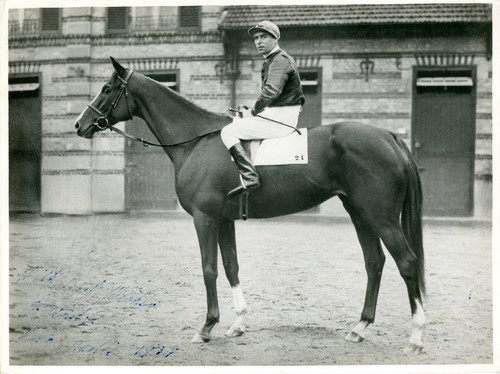
This race honours the memory of one of the greatest ever French mares, a shining ambassador for our breeding stock on foreign soil, a two-time winner of the Prix de l’Arc de Triomphe, and unquestionably the most popular mare to take to the track in the intervening years between World Wars I and II.
Corrida first gave her name to a low-key race held at Tremblay at the end of July 1950. The race would stay on the card until it closed in late 1967. The Prix Corrida was held at Vichy in 1968 and 1969 and was then subsequently scratched from Parisian racecard until 1978. A new Prix Corrida was set up in 1979, which took place at Saint-Cloud and was given Group III status. It would then travel around somewhat, heading to Evry (1994 and 1995) and Lyons (from 1996-1999, over 2,200 metres) before returning to Saint-Cloud in 2000.
Part of a new programme inaugurated in 2004 exclusively for mares aged four and over, the race moved up a category, being promoted to Group 2 status.
(*): In 2020, the Prix Corrida is run at Lyon-Parilly again, but in June, due to restrictions and reprogramming linked to the coronavirus epidemic.
Corrida
Chestnut mare born in 1932 to Coronach and Zariba (Sardanapale), schooled by Marcel Boussac at the Fresnay-le-Buffard stud farm in Orne. Corrida ran in 33 races, winning just 13, a relatively low tally for such a promising prospect. But life was certainly a grand adventure for this filly with noble roots. Her father Coronach and her mother Zariba had been two of the finest horses of their generation in England and France respectively. From the age of two, Corrida would begin to confirm the hopes borne out of her first-class breeding. Corrida emerged victorious at the Prix Morny, and was second by a head to Pampeiro at the Grand Criterium.
Thus reassured about his filly’s quality, Boussac sent Corrida to be trained at George Lambton’s stable in Newmarket to prepare for her involvement in the much-coveted English classic race season in 1935. Second favourite ahead of the One Thousand Guineas and third favourite for the Oaks, Corrida finished well back in the first race and out of the frame in the second. On the back of another disappointing showing at Royal Ascot, she returned to France where, once the Spring trials had run their course, she began showing her true class. She finished in the frame four times including a third at the Prix de l'Arc de Triomphe (where she ran Samos and Péniche all the way) and a second-place finish at the Prix du Conseil Municipal where she ended a whisker behind winner Come In. Finally, her first victory of the year would come in the Grand Prix de Marseille.
A mere two wins in Corrida’s third year was clearly some way short of her owner’s expectations, although Boussac’s faith in his charge remained great. There was, therefore, no question of Zariba’s daughter not continuing her racing career. Perhaps age endowed Corrida with greater race savvy, or perhaps new trainer John Watts understood her better than previous incumbent William Hall? Whatever the reason, Corrida would finally bring her great talent to bear between the ages of four and five, racking up 11 wins and nine placings in 21 appearances.
At the age of four, she won a staggering seven races: the Prix du Prince de Galles and Prix d'Hédouville at Longchamp racecourse, the Hardwicke Stakes at Royal Ascot, the Prix du Président de la République at Saint-Cloud, the Grand International d’Ostende and her second Grand Prix de Marseille.
She would go on to add a further four wins at the age of five: the Grand Prix du Tremblay, her second Grand International d’Ostende, the Grosser Preis von Reichshauptstadt (ran in September at Hoppegarten, the great Berlin hippodrome) and the Prix de l'Arc de Triomphe. She would repeat her Prix de l'Arc de Triomphe success the following year, becoming the first-ever female to win France’s most prestigious race twice, a feat that was repeated only twice, almost a century later by Trève and Enable.
From that point on it is true that the Queen of the tracks became somewhat prone to distraction, especially during the spring season. Even so, this well-travelled horse was a great ambassador for French breeding stock on the European scene and was much admired in an era soon to experience events that would shake the world to its very core.
As far as her standing as a broodmare is concerned, Corrida would have just one offspring that survived the German occupation of France during the second world war, her foal Coaraze who won the Prix de Jockey Club in 1945. One year on Corrida had disappeared from her pastures at Fresnay-le-Buffard, following the Allied rout of the German army during the battle to reclaim Normandy. All efforts to find her would be in vain.
Foreign competitors
The presence of foreign runners is quite a regular occurrence. Between them they have collected 8 wins.
Four German trainers: Bruno Schütz (Elacata, 1994), Uwe Ostmann (Hollywood Dream, 1995), Andreas Schütz (Elopa, 2005), Mario Hofer (Fair Breeze, 2008).
Two Englishmen: Peter Chapple Hyam (Camporese, 1997) and John Fanshawe (Speedy Boarding, 2016).
One Italian: Valiani Renzetti (Super Tassa, 2000).
One Irishman: Joseph O'Brien (Above the Curve, 2023).
Owners
- Wertheimer Family (6 wins): Athyka (1989), Fabulous Hostess (1992) for Jacques, Trumbaka (2003), Plumania (2010), Solemia (2012), Pensée du Jour (2024) for Wertheimer & Frère.
- Wildenstein Family (2 wins): Ode (1990) for Daniel and Actrice (2004) for Écurie Wildenstein.
Trainers
- André Fabre (8 wins): Fly Me (1984), Galla Placidia (1986), Dièse (1993), Luna Mareza (1995), Plumania (2010), Armande (2017), Morgan Le Faye (2019), Pensée du Jour (2024).
- Christiane Head (5 wins): Athyka (1989), Fabulous Hostess (1992), Trumbaka (2003), Trève (2015).
- Alain de Royer-Dupré (4 wins): Pride (2006), Mandesha (2007), Alpine Rose (2009), Sarafina (2011).
- Three other women saddled a winner: Helena Van Zuylen with Lexa (1998), Valérie Dissaux with Accélération (2001) and Tatiana Puitg with Grace Lady (2013).
Riders
- Olivier Peslier (5 wins): Camporese (1997), Trumbaka (2003), Actrice (2004), Plumania (2010), Solemia (2012).
- Henri Samani (3 wins): Tintagel (1979), Lady Tamara (1985), Birthday Fever (1988).
- Thierry Jarnet (3 wins): Dièse (1993), Luna Mareza (1996), Trève (2015).
- Pierre-Charles Boudot (3 wins): Siljan’s Saga (2014), Armande (2017), Bateel (2018).