
Morny History: One of French racing's greatest names
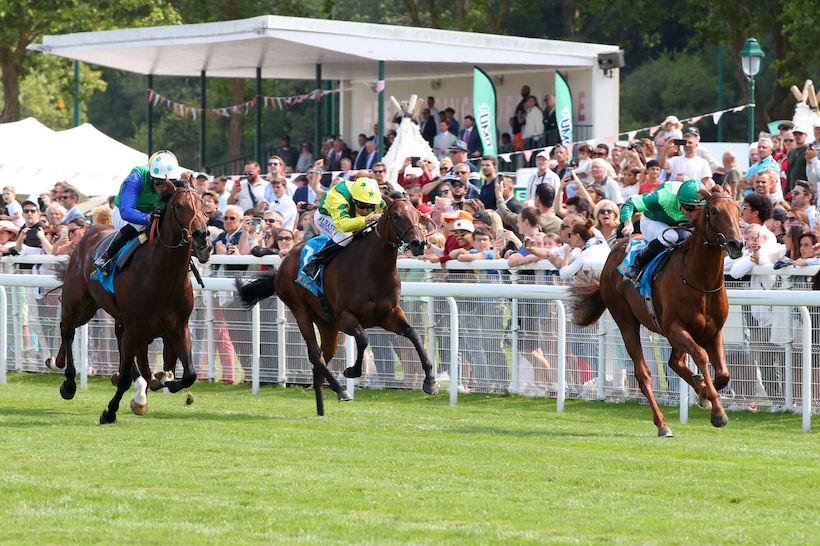
Photo scoopdyga.com
August, Deauville
SUMBE DARLEY PRIX MORNY
Group 1, 2-year-olds, 1,200m/6f, €350,000
Created in 1865
Last winner: WHISTLEJACKET (c2, IRE by No Nay Never and Adventure Seeker, by Bering), owned by Brant, Magnier, Tabor & Smith, bred by Camas Park Stud, Lynch-Bages & Summerhill Farm, trained by Aidan O'Brien, ridden by Ryan Moore.
Record-time : 1’07’’90, Arcano (2009)
The race will be run in 2025 for the 155th time.
The 2024 edition
Deauville, Sunday, August 18th, 2024 – The €350,000 Sumbe Prix Morny (Gr1), Deauville's championship race for 2-year-olds over six furlongs, witnessed another Irish triumph, marking the fifth victory for Aidan O'Brien, the most successful active trainer in the race's history.
The winner, Whistlejacket (No Nay Never), is a chestnut colt, reminiscent of the 18th-century champion who served as a model for George Stubbs and likely inspired his name. This was his sixth career start, just eight days after his second-place finish in the Keeneland Phoenix Stakes (Gr1) at the Curragh. Drawn favourably in stall two, this representative of Peter Brant, in partnership with the principal Coolmore associates, was able to race along the rail and quickly assume the lead, flanked by Arabie (Dandy Man), winner of the Prix Robert Papin (Gr2), and the keen-going Estepona (Mehmas) in the centre of the track. In the final two furlongs, the closers had to navigate around the leading group, and Rashabar (Holy Roman Emperor) mounted a strong challenge to the winner all the way to the line. However, racing alone in the centre of the track, he had to settle for an excellent second place, less than a length behind, just ahead of the filly Earthlight, who followed his run, and the ever-game Arabie, closer to the rail.
Whistlejacket is a full brother to the champion 2-year-old Little Big Bear (No Nay Never), winner of the 2022 Phoenix Stakes (Gr1). He was sold for £500,000 at the Tattersalls sales to Michael Vincent O'Brien and White Birch Farm, Peter Brant's breeding operation. His dam, Adventure Seeker (Bering), bred by the Widenstein family and a granddaughter of the champion mare All Along, was sold in foal to Siyouni for €125,000 at the dispersal of the stud in 2016 to Brendan Bashford Bloodstock.
History
The Prix Morny was set up in 1865, the second year that races were held at Deauville, under the name Prix de Morny and over a distance of 5 furlongs. It was established in memory of the Duc de Morny, who had passed away at the beginning of the same year. Its first winner was the filly Puebla II whose owner, A.Desvignes, won 9,150 French Francs. In 1871 its name was changed to the Prix de Deux Ans, but it reverted to the Prix Morny (without the "de") in 1911. It was not held between 1914 and 1918, or in 1940. It was transferred to Longchamp in 1941 and 1942 (over 5 furlongs) and 1944 (over 6 ½ furlongs), and to Maisons-Lafitte in 1943 and 1945.
In 1866 and 1867 its running distance was 6 furlongs, in 1868 and 1869 it became 6 ½ furlongs, and it was then lengthened to 7 furlongs between 1870 and 1886. It has been run at 6 furlongs since 1887, except on the aforementioned occasions. Weighting was in place until 1920 and could be up to 5kg.
In 2005 the race’s sponsorship was taken over by Darley, a name used by the Sheik Mohammed Al Maktoum for his various stud farms, which led to a 100,000 € increase in prize money. It has also become the #DarleySeries final leg after the Darley Prix Robert Papin (Gr2) and the Darley Prix de Cabourg (Gr3).
Morny
Auguste de Morny (1811-1865) was the biological son of the general of Flahaut and Queen Hortense, and was, therefore, the half-brother of the future emperor Napoleon III. After serving as a sub-lieutenant in Algeria, he then went on to found a large and prosperous beet-sugar factory near Clermont-Ferrand. As a delegate of the Puy-de-Dôme in 1842 and in charge of the Home Office, he took part in the coup d’état on 2nd December 1851, which would lead to his half-brother taking power. He became a member of the Corps Législatif in 1852 and was its president from 1854 right up to his death on 8th March 1865. He had three hobbies: artwork, theatre (he wrote scripts under the name Saint-Remy) and horses. Elected member of the Jockey Club in 1838, Morny raced for the first time that very same year, on the 3rd June at Versailles, for a 2 000 FF bet. His filly Méprisée, ridden by Flatman, was beaten by Mendicant, owned by the Prince of Moscow. One week later she again had to settle for second place out of three runners in the fourth race, a handicap. Morny’s colours (pink jersey, pink cap) were not very successful, despite his best efforts. His horses were trained by Tom Hurst at Lamorlaye and later by Henry Jennings at La Croix-Saint-Ouen. To begin with, his horses were bred at the Lonray stud, and then he bought Nicolas-Joseph Rieussec’s stud at Viroflay, where he brought in the famous West Australian in 1860. This 1853 Triple Crown champion (Two Thousand Guinea Stakes, English Derby, St Leger Stakes) and winner of the Ascot Gold Cup was bought for 4,000 guineas after its previous owner passed away. At the end of 1865, following the death of the Duc de Morny, the Viroflay stud was sold for 135,000FF and West Australian was bought by the Stud Administration for 31,000FF and moved to Pin. Unfortunately, West Australian’s French progeny was as disappointing as it had been on the other side of the channel. On the flat in 1856, the Duc de Morny’s best runner, Diamant had the bad luck of crossing the finishing line in the Prix du Jockey Club at Chantilly on the same stride as Lion, only for the latter to finish two lengths ahead of Diamant just one hour later, during a second heat deemed necessary to separate the two runners. Ruy Blas, one of his stock born in 1864, just one year before Morny’s death and sold for just 900FF, went on to win fourteen races as a four-year-old, including the Grand Prix de Bade. The Duc de Morny’s other notable horses were Violette, the 1860 winner of the Poule des Produits (later known as the Prix Daru) and second in the Poule D’Essai; Sauterelle, winner of the Prix du Gros Chêne in 1862; Gédéon, who tasted victory in the 1864 Prix de Longchamp (Prix Hocquart); and Noélie, runner-up in the Prix de Diane in 1862 who then went on to win the 1864 Grand Prix de l’Empereur (Prix Gladiator). On 8th April 1865, the Duc de Morny’s twenty-seven horses were sold at Chantilly for a total of 337,950FF.
Without Morny, the Longchamp racecourse, the Grand Prix de Paris and the racing at Deauville would not be what they are today. With great foresight, he anticipated the increase in racing and tourism. Longchamp opened in 1857, was chosen to give the Parisian racing a suitable, permanent setting, as opposed to the appalling temporary site used on the Champ de Mars since 1807. The financially rewarding event, the Grand Prix de Paris, whose winner sought to gain 100,000FF, was set up by the Duc de Morny to give the capital the chance to host a top sporting event whose popularity among the international jet set has been unrivalled since its launch in 1863. He decided to found Deauville, with its casino and races inextricably linked in the Duc’s opinion, to compete with Baden, a thermal spa in Germany, which in 1858 began hosting races with the aid of the Sociéte d’Encouragement. So on Sunday, 14th August 1864, on the banks of the Touques River, the first race meeting took place. Gentilhomme entered and wore the Duc de Morny’s colours in the second race. He was beaten by Henri Delamarre’s filly Fidelité. But the Duc was known for his generosity, even in defeat. He presented a whip to E.Delchet, the winner of a “poule de hacks” reserved for gentleman-riders. There would be no second year of racing at Deauville for the Duc de Morny, as he died five months before it took place.
Fillies
Fillies have won 53 out of 150 race editions, accounting for about 35% of the total. This percentage of wins is much higher than in most mixed races and highlights the characteristic early development of young mares.
Foreign runners
The Prix Morny was opened to horses from around the world in 1875, only to close its doors to foreign horses in 1909, even though no foreign horse had tasted victory until then. The ban was lifted in 1947, and several British competitors were subsequently seen at Deauville, where one of them, Delirium, took off with the Prix Morny for the first time. Lorenzaccio, who had already finished in the frame in the Prix Robert Papin, posed a threat in 1967. Still, Madina finished comfortably in the lead, just like another filly, Princeline, had done the year before by trouncing the four-strong British coalition, two of which (Folle Rousse and Hopiana) had taken the first and second places at the Prix Robert Papin. No horse could deny the invincible My Swallow, with his collection of five French and two British wins under his girth, the second-ever English victory in 1970. It was twenty-four years before the third visitor tasted victory, namely Hoh Magic, a filly trained at Newmarket by Michel Bell. But this win led to an influx of foreign winners –since then, there has only been one French victory, that of Charge d’Affaires in 1997. Four English products, Tagula (1995), Bahamian Bounty (1996), Bad As I Wanna Be (2000), Elusive City (2002) and three from Ireland under Aiden O’Brien, Orpen (1998), Fasliyev (1999) and Johannesburg (2001) kept victory out of French grasp until 2003 and 2004 when it was reclaimed thanks to Whipper and Divine Proportions. The foreigners were back in the winner’s circle in 2005 with Silca’s Sister, and since then, the French have won only twice, with Dabirsim in 2011 and Earthlight in 2019. Three US victories by young speedsters trained by Wesley Ward, No Nay Never (2013), Lady Aurelia (2016) and Campanelle (2020) complete the picture.
A breeding ground for classic winners
Several horses who have taken the laurels at the Prix Morny as a 2 year-old have gone on to taste victory in classic races at 3 years of age. For example, among the winners are: Widgeon (1887) Poule d'Essai, Le Sagittaire (1894) Prix Lupin, Vinicius (1902) Poule d'Essai, Val d'Or (1904) Poule d'Essai, Porte Maillot (1911) Poule d'Essai, Sardanapale (1913) Jockey Club, Grand Prix de Paris, Sourbier (1919) Jockey Club, Fairy Legend (1926) Poule d'Essai, Diane, Château Bouscaut (1929) Jockey Club, Pearl Cap (1930) Poule d'Essai, Diane, Arc de Triomphe, Brantôme (1933) Poule d'Essai, Lupin, Royal Oak, Arc de Triomphe, Mistress Ford (1935) Diane, Esmeralda (1941) Poule d'Essai, Coaraze (1944) Jockey Club, Amour Drake (1948) Poule d'Essai, Auriban (1951) Jockey Club, Chingacgook (1954) Grand Prix de Saint Cloud, Apollonia (1955) Poule d'Essai, Diane, Soleil (1965) Poule d'Essai, Nonoalco (1973) Two Thousand Guineas Stakes, Vitiges (1975) Champion Stakes, Blushing Groom (1976) Poule d'Essai, Irish River (1978) Poule d'Essai, Siberian Express (1983) Poule d'Essai, Hector Protector (1991) Poule d'Essai, Zafonic (1992) Two Thousand Guineas Stakes, Divine Proportions (2004) Poule d'Essai, Diane. Among those who finished in the frame or were not placed are: Saltarelle, Stockholm, Barberine, Stuart, Arreau, Champaubert, Gouvernant, Flying Star, Banshee, Madrigal, Mary Legend, Rodosto, Bipearl, Mary Tudor, Cillas, Djebel, Caravelle, Ardan, Mistral, Coronation, Sicambre, Midget, Dan Cupid, Kashmir II, Ma Biche, Masarika, River Lady and the superlative Miesque.
Morny and Jacques Le Marois
Nine horses have gone on to win the Prix Jacques Le Marois after bringing the Prix Morny home at 2. They are Zariba (1922), Pearl Cap (1931), Sémiramide (1939), Coaraze (1945), Amour Drake (1949), Nonoalco (1974), Irish River (1979), Hector Protector (1991) and Whipper (2004).
Owners
- Marcel Boussac (13 wins): Durzetta (1920), Zariba (1921), Banstar (1925), Cécias (1932), Corrida (1934), Sémiramide (1938), Esméralda (1941), Coaraze (1944), Nirgal (1945), Cadir (1946), Auriban (1951), Cordova (1953), Apollonia (1955).
- Edmond Blanc (8 wins): Marly (1892), Lucie (1899), Farnus (1901), Vinicius (1902), Val d'Or (1904), Mehari (1908), Porte Maillot (1911), Marka (1912).
- Mrs John Magnier (partner, 8 wins): Orpen (1998), Fasliyev (1999), Johannesburg (2001), Myboycharlie (2007), Bushranger (2008), No Nay Never (2013), Blackbeard (2022), Whistlejacket (2024).
- Alphonse de Rothschild (4 wins): Louis d'Or (1879), Strelitz (1880), Fresca (1893), Thélème (1903).
- Famille Niarchos (4 wins): Machiavellian (1989), Hector Protector (1990), Coup de Génie (1993), Divine Proportions (2004).
Trainers
Robert Denman (8 wins): Present Times (1884), Frapotel (1886), Farnus (1901), Vinicius (1902), Val d'Or (1904), Mehari (1908), Porte Maillot (1911), Marka (1912).
François Boutin (7 wins): Nonoalco (1973), Super Concorde (1977), Tersa (1988), Machiavellian (1989), Hector Protector (1990), Arazi (1991), Coup de Génie (1993).
Henry Jennings (5 wins): Eole II (1870), Seul (1871), Fusion (1875), Mantille (1877), Favorite (1881).
Richard Carver (5 wins): Kantar (1927), Ad Astra (1937), Amour Drake (1948), Ksarinor (1949), Pharamond (1959).
Charles Semblat (5 wins): Coaraze (1944), Nirgal (1945), Cadir (1946), Auriban (1951), Cordova (1953).
Aidan P. O’Brien (5 wins): Orpen (1998), Fasliyev (1999), Johannesburg (2001), Blackbeard (2022), Whistlejacket (2024).
Alec Head (4 wins): Sanguine (1950), Chingacgook (1954), Darannour (1962), Princesse Lida (1979).
Charles Pratt (3 wins): Macaron (1874), Swift (1878), Daphnis (1895).
J.-C. Watson (3 wins): Fresca (1893), Justitia (1898), Thélème (1903).
William Duke (3 wins): Prestige (1905), Messidor III (1909), Manfred (1910).
Frank Carter (3 wins): Necklace (1928), Pearl Cap (1930), Mistress Ford (1935).
Etienne Pollet (3 wins): Neptune II (1957), Prudent (1961), Grey Dawn (1964).
François Mathet (3 wins): Solitude (1960), Amber Rama (1969), Blushing Groom (1976).
John Fellows (3 wins): Ancient Regime (1980), Seven Springs (1984), Regal State (1985).
Wesley Ward (3 wins): No Nay Never (2013), Lady Aurelia (2016), Campanelle (2020).
Riders
- George Stern (10 wins): Eperon (1900), Farnus (1901), Vinicius (1902), Val d'Or (1904), Mehari (1908), Porte Maillot (1911), Marka (1912), Durzetta (1920), Zariba (1921), Banstar (1925).
- Edgar Rolfe (6 wins): Mantille (1877), Louis d'Or (1879), Strelitz (1880), Directrice (1883), Widgeon (1887), Fontanas (1888).
- Lanfranco Dettori (6 wins): Bahaman Bounty (1996), Dabirsim (2011), The Wow Signal (2014), Shalaa (2015), Lady Aurelia (2016), Campanelle (2020).
- Jacques Doyasbère (5 wins): Coaraze (1944), Nirgal (1945), Cadir (1946), Sanguine (1950), Cordova (1953).
- Gérald Mossé (5 wins): Tersa (1988), Arazi (1991), Chargé d’Affaires (1997), Bad As I Wanna Be (2000), Reckless Abandon (2012).