
Malleret History: A broodmares' academy
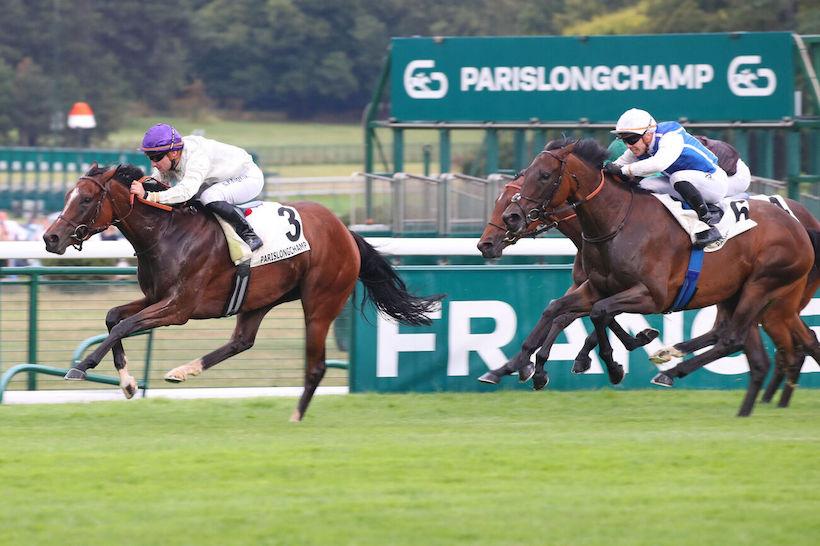
Photo scoopdyga.com
July, ParisLongchamp
Prix de Malleret
Group 2, 3-year-old fillies, 2,400m/12f, €130,000
Created in 1907
Last winner: Survie (f3, FRA by Churchill ex Sotteville, by Le Havre), owned by Gérard Augustin-Normand, bred by Franklin Finance, trained by Nicolas Clément, ridden by Stéphane Pasquier.
Record-time: 2’28’’0, par Wemyss Bight (1993), then Another Dancer (1998).
In 2025, the Prix de Malleret will be run for the 114th time.
The 2024 edition
Saturday, July 13, 2024, ParisLongchamp Racecourse (Paris). - Run over 1m1/2, the €130,000 Prix de Malleret (Gr2) is a race for 3-year-old fillies that could be nicknamed the Paris Oaks. The favourite Survie (Churchill), second in the Prix de Diane Longines (Gr1) over 10.5 furlongs last time out, held off a strong late run from Mosaïque (Dubawi), who couldn’t quite keep up in the end after a fast second last furlong. Candala (Frankel), eighth in the Chantilly classic, had tracked the leader Sinology (Study of Man) along the rail but struggled to pull herself out of there and ultimately couldn’t overtake Mosaïque, finishing nearly a length behind in 3rd place.
Survie maintained her effort to the finish line, winning by a clear length. She posted the fastest time over the final furlong, clocking 11.2 seconds in the lead.
This victory marks Survie’s third win. Her owner, Gérard Augustin-Normand, bred her. Survie is the third foal out of Sotteville, a talented mare who won three consecutive races at 2 and 3 years old, including the Derby du Languedoc (L), and placed third in the Prix Minerve (Gr3) and Prix de Royallieu (Gr2). Sotteville is a full sister to Crisolles (Le Havre), placed in the Prix de la Nonette (Gr2), and is also the dam of Barfleur (Rajsaman), a handicap mare, and an unraced 4-year-old gelding, Saint-Hymer (Olympic Glory). She also has a 2-year-old by Mehmas, trained by Stéphanie Nigge, and a filly by Zarak, born in 2023.
History
It was in 1907 that the Prix de Malleret, up until then contested over a course of 1 mile and open to both 3-year-old colts and fillies, was set aside solely for fillies as a consolation event for the Prix de Diane – run ten days earlier over a mile and 2 1/2 furlongs. Consequently, in 1907, La Belle II, Anémone II and Ad Gloriam, having come 3rd, 4th and 5th in the Prix de Diane, lined up in this new-format Prix de Malleret, where they finished 2nd, 3rd and 4th (but in reverse order) after being outstripped by a newcomer, Aux Armes, who would later foal the 1914 Prix de Diane winner, Alerte VI.
With one exception (1 mile 1 ¾ furlong in 1970), the distance remained unchanged for eight decades. It was only in 1987 that it was increased to a mile and a half, its current distance. For a long time, Longchamp was the sole venue for the Prix de Malleret, which was only switched to Maisons-Laffitte in 1943 and 1944 due to war, but from 2001, the race relocated to Saint-Cloud to reinforce the Grand Prix day race card. In 2020, however, it was run later in the season at ParisLongchamp because of the coronavirus which affected the 1st semester, and it remained there since, pushed two weeks later to be incorporated in the Grand Prix de Paris' card
The Prix de Malleret honours list includes the names of many mares renowned for their performance on the track or at stud. These include: in 1920 Lasarte (dam of Thor, Jockey Club), in 1921 Ad Gloriam II (grandmother of Le Pacha), in 1926 Carissima (dam of the famous Pharis), in 1929 Calandria (Prix Royal Oak, Prix Vermeille), in 1935 Samos (Arc de Triomphe), in 1937 Barberybush (grandmother of Right Royal), in 1944 La Belle du Canet (Prix Vermeille), in 1947 Madelon (3rd in Arc de Triomphe), in 1955 Picounda (3rd in Arc de Triomphe), in 1957 Denisy (2nd in Arc de Triomphe), in 1969 Glaneuse (dam of Gold River), in 1972 Licata (dam of Acamas and Akiyda), in 1973 Virunga (dam of Vin de France, grandmother of Victoire Bleue), in 1989 Young Mother (Prix Vermeille), in 1990 Miss Alleged (Breeders' Cup Turf), in 1991 Magic Night (Prix Vermeille), in 1993 Wemyss Bight (Irish Oaks), in 1999 Sage et Jolie (mother of Sageburg), in 2002 Pearly Shells (Prix Vermeille).
Lune d’Or, dam of Japanese Group winner Fièrement, Royal Highness, dam of the young sire Free Port Lux, or Légèreté, dam of Pilote, also feature in the roll of honour, like the dam of the good Mot Juste, Time On.
Malleret
Malleret is an estate – benefiting from a mild climate, almost always settled – in the Medoc region where its owner Paul Clossmann set up thoroughbred stables and a training ground around 1875. On four occasions, his silks (orange and violet-ringed jersey, black cap) were victorious in the Derby du Midi (main race for 3 year-olds, held at Bordeaux) thanks to Le Mormon (1877), Arnold (1880), Chapeau Rouge (1887) and Saint-Hubert (1888). When Paul Clossmann died, the estate passed into the hands of his sister, Mrs d'Escayrac, who in turn left it to her daughter, Mrs du Vivier. Her husband, Philippe du Vivier de Fay-Solignac, developed the Malleret stable and sold the yearlings it produced. Among those to distinguish themselves were Verte Allure (Grand Steeple-Chase de Dieppe 1928), Tape à l'Œil (Grand Prix du Printemps at Saint-Cloud, 1928), Rais de Cœur (Prix Georges Trabaud at Marseille, 1928) and Pontet Canet (Prix Jacques Le Marois at Deauville, 1930). Upon the death of Philippe du Vivier, his widow continued to breed horses for a short while, before leasing the stud farm in 1936 to Paul and René Duboscq, who entered into a partnership with her son, Renaud du Vivier. Consequently, Malleret went on to produce La Sorellina (Prix de Diane and Prix de l'Arc de Triomphe 1953) and her half-brother Silnet (second in the same edition of the Arc de Triomphe). After the partnership broke up in 1963, Vivier continued breeding horses alone at Malleret, producing La Lagune (Oaks 1968), who was sold as a yearling, and La Manille who, in his own colours, had an excellent season in 1971, clinching the Prix Messaline, coming 2nd in the Prix Pénélope and Prix Pomone and 3rd in the Oaks. When Vivier passed away in 1985, Malleret was taken over by his nephew Bertrand du Vivier, but when he too died, the domain was sold by his son Alain to a third party who chose not to maintain Malleret’s thoroughbred breeding tradition.
Owners
- Marcel Boussac (6 wins): Lasarte (1920), Carissima (1926), Bellecour (1927), Argolide (1938), Damaka (1951) et Licata (1972).
- Khalid Abdullah (6 wins): Wemyss Bight (1993), Bonash (1994), Privity (1995), High Praise (2003), Treat Gently (2008), Raclette (2022).
- Aga Khan IV (4 wins): Kozana (1985), Shamadara (1996), Ashalanda (2009) et Dolniya (2014).
- Edouard Martinez de Hoz (4 wins): Lucide (1925), Calandria (1929), Merveille (1930) et Fair Dolly (1948).
Trainers
- André Fabre (11 wins): Zoumorrod (1987), Wemyss Bight (1993), Bonash (1994), Sage et Jolie (1995), Diamilina (2001), Légèreté (2007), Treat Gently (2008), Strathspey (2017), Waldlied (2018), Babylone (2021), Raclette (2022).
- Frank Carter (6 wins): Allamanda (1911), Lucide (1925), Calandria (1929), Merveille (1930), Samos (1935), Barberybush (1937).
- Pascal Bary (5 wins): Miss Alleged (1990), Privity (1995), Royal Highness (2005), Testostérone (2011), Vaucelles (2020).
- François Boutin (4 wins): Antrona (1976), Calderina (1978), Grease (1982), Trishyde (1992).
- Christiane Head (4 wins): Reine Mathilde (1984), Animatrice (1988), Silver Fun (1997), America (2000).
- Alain de Royer-Dupré (4 wins): Kozana (1985), Shamadara (1996), Ashalanda (2009), Dolniya (2014).
Riders
- Charles-Henri Semblat (7 wins): Edera (1923), Lucide (1925), Carissima (1926), Calandria (1929), Merveille (1930), Nantua (1931), Samos (1935).
- Olivier Peslier (6 wins): Privity (1995), Sage et Jolie (1995), Diamilina (2001), Time On (2006), Légèreté (2007), Raclette (2022).
- Yves Saint-Martin (4 wins): Mirna (1964), Virunga (1973), Leandra (1981), Kozana (1985).